Love this? Save it for later!
Share the inspiration with your friends
My roommate asked why I couldn’t just throw the whole squash in the pot without peeling it first. I stared at her like she’d suggested we cook it in the dishwasher. “The skin is too tough,” I said, already reaching for my vegetable peeler. “It’ll be stringy. Trust me, I’ve been making soup for years.” She shrugged and went back to chopping cilantro, and I felt a tiny pang of something—maybe embarrassment for being so dismissive. But I’d learned the hard way that kabocha squash skin doesn’t break down like zucchini does, right?
Wrong.
I started to explain why that wouldn’t work—then stopped. Honestly, I had no real evidence. I’d just always peeled it because that’s what the recipes said. So I did something I rarely do on a Tuesday night: I shut up and let her be right. We cubed the squash with the skin on, tossed it in the pot, and I braced for disaster. Twenty minutes later, I was blending that soup with a hand blender, and let me tell you—the texture was unreal. Silky. Velvety. And not a single stringy bite.
That moment changed how I approach cooking. This velvety kabocha squash curry soup is now my go-to when I need something fast, comforting, and honestly a little impressive. It’s the kind of recipe that makes you look like you spent hours in the kitchen when really, you just let the squash do the heavy lifting. Maybe you’ve been there—stubbornly stuck in your ways, convinced a certain step is non-negotiable, only to discover you were wrong the whole time. That’s this soup for me. A humble reminder that sometimes the best lessons come from letting someone else take the lead.
Why You’ll Love This Recipe
I’ve tested this soup at least a dozen times, tweaking the spice level, adjusting the coconut milk ratio, and even trying it with different squash varieties. This version—the one with the skin left on—won every single time. Here’s why it stands out:
- Quick & Easy: From fridge to bowl in under 20 minutes. No peeling, no fuss, just chop and simmer.
- Simple Ingredients: You probably have most of these in your pantry right now. Coconut milk, curry paste, onion, garlic—that’s it.
- Perfect for Busy Weeknights: It’s hearty enough to be a meal on its own but light enough that you won’t feel sluggish afterward.
- Crowd-Pleaser: I’ve served this to my spice-wary mom and my curry-obsessed neighbor, and both asked for seconds.
- Unbelievably Velvety: The kabocha skin breaks down into this luscious, creamy texture that no peeled squash can replicate. Trust me on this one.
What makes this recipe different from every other squash soup out there is the technique. Most recipes have you peeling, seeding, and roasting the squash first—which takes forever. This one skips all that. The skin adds body, the curry adds warmth, and the coconut milk ties it all together into something that feels indulgent without being heavy. It’s comfort food reimagined: healthier, faster, and somehow even more satisfying.
This is the soup I make when I want to feel good about what I’m eating but don’t want to sacrifice flavor. It’s the soup that makes you close your eyes after the first bite, not because it’s fancy, but because it just tastes right.
What Ingredients You Will Need
This recipe relies on a short list of wholesome ingredients that work together to create big flavor with minimal effort. Most are pantry staples, and the ones that aren’t are easy to find at any grocery store.
For the Soup Base
- 1 medium kabocha squash (about 2-3 pounds) — Look for one that feels heavy for its size. The skin should be firm and free of soft spots. I prefer organic when I can find it, since we’re leaving the skin on.
- 1 tablespoon coconut oil (or any neutral oil) — Adds a subtle richness that complements the coconut milk later.
- 1 medium yellow onion, diced — Sweating the onion first builds the flavor foundation.
- 3 cloves garlic, minced — Fresh is best here; the pre-minced stuff in jars just doesn’t have the same punch.
- 1 tablespoon fresh ginger, grated — I keep a knob of ginger in the freezer so it’s always ready to grate. No peeling needed that way.
- 2 tablespoons red curry paste — I prefer Thai Kitchen or Mae Ploy for consistent heat and depth. Adjust based on your spice tolerance.
- 1 can (13.5 oz) full-fat coconut milk — Light coconut milk works in a pinch, but the soup won’t be as velvety. Save the light stuff for smoothies.
- 3 cups vegetable broth — Low-sodium is ideal so you can control the salt level. Chicken broth works too if you’re not keeping it vegetarian.
- 1 tablespoon maple syrup or coconut sugar — Just enough to balance the curry’s heat and the squash’s natural sweetness.
- Salt and black pepper, to taste — Start with 1/2 teaspoon salt and adjust at the end.
For Garnish (Optional but Recommended)
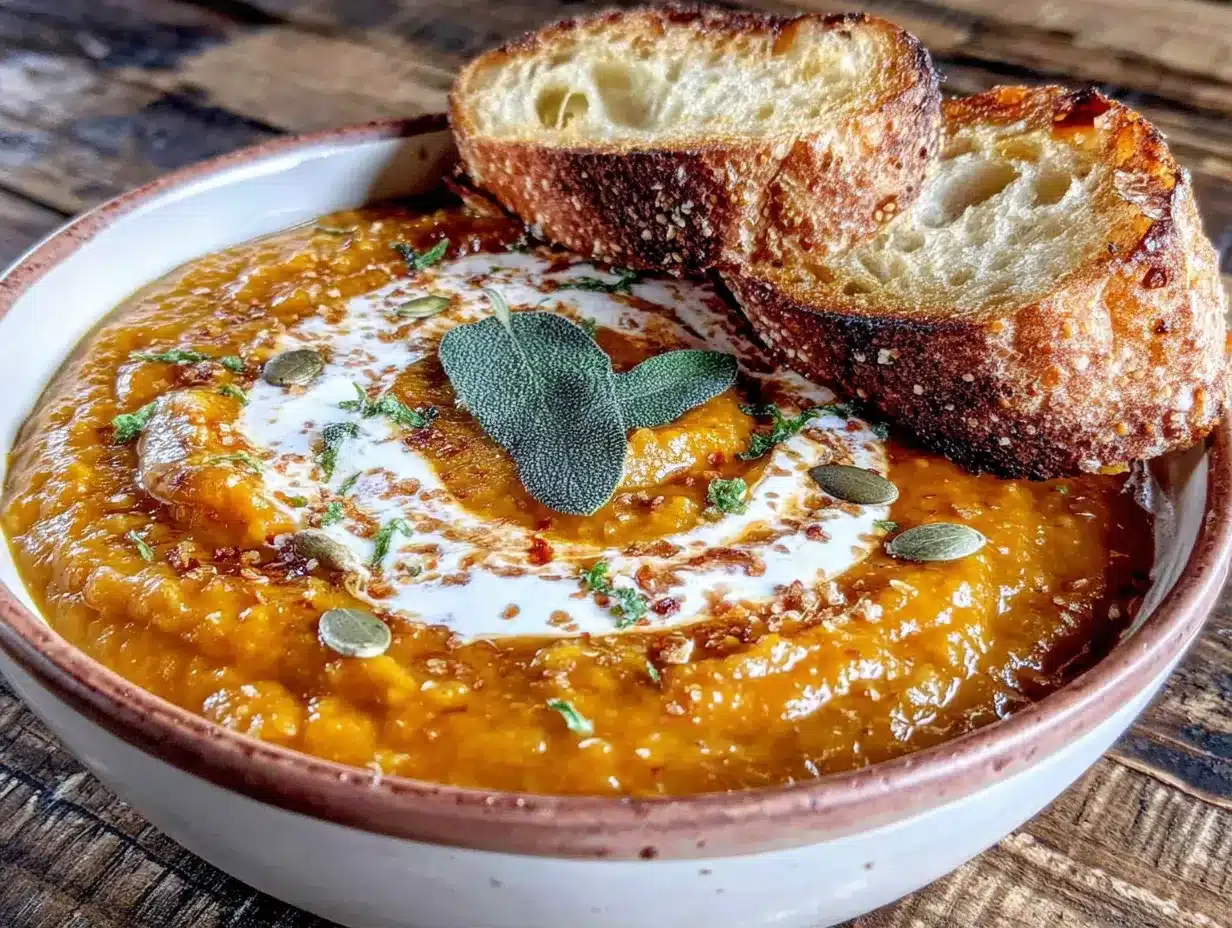
- Fresh cilantro, chopped — Adds a bright, herbaceous finish.
- Toasted pumpkin seeds — For crunch and a little extra nutrition.
- A drizzle of coconut milk — Makes it look restaurant-worthy.
- Lime wedges — A squeeze of lime right before eating brightens everything up.
Ingredient Tips: If you can’t find kabocha squash, buttercup or red kuri squash are excellent substitutes—they both have edible skin that softens nicely. For a lower-carb option, swap the maple syrup with a few drops of stevia or omit it entirely. The squash is sweet enough on its own, honestly.
Equipment Needed
You don’t need a fancy kitchen to make this soup. Here’s what you’ll need:
- Large pot or Dutch oven (4-5 quart) — I use my trusty enameled cast iron pot. It distributes heat evenly and holds the soup well for blending.
- Chef’s knife and cutting board — A sharp knife makes cutting through the squash much easier. Kabocha is dense, so take your time.
- Immersion blender — This is my preferred tool for blending hot soup directly in the pot. No transferring hot liquid in batches, no mess. I use a Cuisinart model that’s held up for years.
- Regular blender (if you don’t have an immersion blender) — Let the soup cool slightly before blending, and work in batches. Fill the blender no more than halfway to avoid explosions.
- Wooden spoon or spatula — For stirring the aromatics.
- Measuring spoons and cups — For the curry paste, coconut milk, and broth.
Budget-Friendly Tip: If you don’t own an immersion blender, a regular blender works fine. Just be patient and let the soup cool for 10 minutes before blending. And always, always remove the center cap from the blender lid and cover it with a towel to let steam escape.
Preparation Method
This comes together fast, so have everything prepped before you start cooking. Trust me, you don’t want to be grating ginger while your onions are burning.
- Prepare the squash (5 minutes): Wash the kabocha squash thoroughly under running water. Cut it in half through the stem end using a sharp chef’s knife—go slow and steady, this squash is tough. Scoop out the seeds and stringy bits with a spoon (save the seeds for roasting if you’re feeling ambitious). Cut the halves into 1-inch chunks. No need to be precise; they just need to cook evenly.
- Sweat the aromatics (5 minutes): Heat the coconut oil in your large pot over medium heat. Add the diced onion and cook for 3-4 minutes, stirring occasionally, until translucent and fragrant. Add the minced garlic and grated ginger, and cook for another 30 seconds until you can smell them. Don’t let the garlic brown—it turns bitter fast.
- Bloom the curry paste (1 minute): Add the red curry paste to the pot and stir it into the onion mixture. Let it cook for about 1 minute, stirring constantly. This step wakes up the spices and deepens the flavor. Your kitchen will smell incredible right about now.
- Add the squash and liquids (2 minutes): Toss in the cubed squash, followed by the coconut milk and vegetable broth. Stir everything together, scraping up any bits stuck to the bottom of the pot. Add the maple syrup and a pinch of salt.
- Simmer until tender (15-18 minutes): Bring the soup to a boil, then reduce the heat to low and let it simmer uncovered. The squash is done when you can easily pierce a piece with a fork—usually around 15 minutes. If your cubes are larger, give it a few extra minutes. The liquid should be bubbly but not boiling aggressively.
- Blend until velvety (2 minutes): Remove the pot from the heat. If using an immersion blender, submerge it fully and blend until completely smooth. If using a regular blender, let the soup cool for 10 minutes, then blend in batches. Be careful—hot liquid expands. I once had a blender lid pop off and spray soup all over my ceiling. Not fun. Work in small batches and hold the lid down with a towel.
- Adjust and serve (1 minute): Taste the soup and adjust seasoning. More salt? Another squeeze of lime? A touch more maple syrup? This is your chance to dial it in. Ladle into bowls and top with your chosen garnishes.
Cooking Tips & Techniques
I’ve made this soup more times than I can count, and I’ve learned a few things the hard way. Here’s what I wish someone had told me:
- Don’t skip blooming the curry paste. I know it’s tempting to just dump everything in and let it boil, but that extra minute of cooking the paste in oil makes a huge difference. It releases the fat-soluble flavors that would otherwise stay muted.
- Cut the squash into uniform pieces. I’m not saying you need a ruler, but try to keep the chunks roughly the same size. If some are tiny and others are huge, the small ones will turn to mush while the big ones stay crunchy. Aim for 1-inch cubes.
- Watch the salt. Curry paste and vegetable broth both contain sodium, so go easy on the salt until the very end. You can always add more, but you can’t take it out.
- If the soup is too thick, thin it with broth or water. Different squash varieties release different amounts of liquid. If your soup looks more like a puree than a soup, add a splash of broth until it reaches your desired consistency.
- If the soup is too thin, let it simmer longer. Just let it bubble away uncovered for another 5-10 minutes. The liquid will reduce and the soup will thicken naturally.
My biggest failure: I once tried to make this soup in a regular blender without letting it cool first. The lid shot off like a rocket, soup splattered everywhere, and I spent an hour cleaning curry off my cabinets. Learn from my mistake—always let hot soup cool before blending in a countertop blender, or use an immersion blender to keep everything in the pot.
Variations & Adaptations
This soup is endlessly adaptable. Here are some of my favorite twists:
- Make it vegan (it already is!): This recipe is naturally vegan as written. Just double-check your curry paste—some brands contain shrimp paste. Look for a vegan-friendly label if that’s a concern.
- Add protein: Stir in a cup of cooked chickpeas or shredded rotisserie chicken after blending. It adds heartiness without changing the flavor much.
- Switch up the curry: Try green curry paste for a milder, herbaceous version, or yellow curry paste for something more turmeric-forward. Each one gives the soup a completely different personality.
- Roast the squash first: If you have extra time, roast the cubed squash at 400°F for 25 minutes before adding it to the pot. It adds a caramelized depth that’s lovely, though it pushes the total time to about 45 minutes.
- Make it spicy: Add a minced Thai bird chili or a teaspoon of sriracha along with the curry paste. I did this once for a winter dinner party and it was a hit.
- Low-FODMAP version: Skip the onion and garlic, and use garlic-infused oil instead. Replace the onion with the green parts of leeks or a handful of chopped fennel. The soup will still be delicious, I promise.
My personal favorite variation? I add a tablespoon of peanut butter along with the curry paste. It sounds weird, but it adds this subtle nuttiness that pairs beautifully with the squash. Try it once—you’ll see what I mean.
Serving & Storage Suggestions
This soup is versatile enough to serve in multiple ways. Here’s how I like to do it:
- Serving temperature: Hot, right off the stove. But honestly, it’s also surprisingly good at room temperature on a warm day.
- Presentation: Ladle the soup into wide bowls, drizzle a spoonful of coconut milk on top, and drag a toothpick through it to create swirls. Sprinkle with cilantro and pumpkin seeds for color and crunch.
- What to serve with it: A crusty baguette for dipping, a simple green salad with lime vinaigrette, or even steamed rice if you want to make it a heartier meal. I’ve also poured it over cooked quinoa for a lunch bowl situation.
- Storage: Let the soup cool completely, then transfer it to an airtight container. It keeps in the refrigerator for up to 5 days. The flavors actually deepen overnight, so it tastes even better the next day.
- Freezing: This soup freezes beautifully. Pour it into freezer-safe bags or containers, leaving an inch of headroom for expansion. It keeps for up to 3 months. Thaw overnight in the fridge before reheating.
- Reheating: Warm it gently on the stovetop over medium-low heat, stirring occasionally. If it’s too thick after freezing, add a splash of broth or water to loosen it up. You can also microwave individual portions in 30-second bursts, stirring between each.
Nutritional Information & Benefits
Here’s the nutritional breakdown for one serving (about 1.5 cups), based on 4 servings:
| Nutrient | Amount |
|---|---|
| Calories | 285 |
| Total Fat | 18g |
| Saturated Fat | 14g |
| Carbohydrates | 28g |
| Fiber | 5g |
| Sugar | 10g |
| Protein | 5g |
| Vitamin A | 290% DV |
| Vitamin C | 25% DV |
| Iron | 15% DV |
Kabocha squash is a nutritional powerhouse. It’s packed with beta-carotene (which your body converts to vitamin A), fiber for digestive health, and antioxidants that help fight inflammation. The coconut milk provides healthy medium-chain triglycerides (MCTs) that support brain function. And the ginger and garlic offer immune-boosting properties—perfect for cold and flu season.
Dietary Notes: This soup is naturally gluten-free, dairy-free, and vegan. It’s also relatively low in carbs compared to other squash soups, thanks to the high fiber content. If you’re watching your saturated fat intake, you can use light coconut milk, though the texture won’t be as rich.
Conclusion
This velvety kabocha squash curry soup is proof that sometimes the best recipes come from being wrong. I was so sure the skin had to go, but leaving it on transformed this soup into something I genuinely crave. It’s fast enough for a Tuesday night, fancy enough for guests, and healthy enough to make you feel good about eating the whole bowl.
I hope you give it a try—and maybe even let someone else take the lead in the kitchen. You never know what you’ll discover. If you make this soup, I’d love to hear how it turned out. Did you try a variation? Add something unexpected? Drop a comment below and let me know. And if you loved it, share it with a friend who needs a quick, comforting dinner in their life.
Happy cooking, friends. ❤️
Frequently Asked Questions
Can I use butternut squash instead of kabocha?
Absolutely. Butternut squash works well, though you’ll need to peel it since the skin doesn’t soften the same way. The soup will still be delicious, just slightly less velvety.
Is this soup spicy?
It has a gentle warmth from the red curry paste, but it’s not what I’d call spicy. If you’re sensitive to heat, start with 1 tablespoon of curry paste instead of 2. You can always add more later.
Can I make this in a slow cooker?
Yes! Sauté the aromatics and bloom the curry paste on the stovetop first, then transfer everything to the slow cooker. Cook on low for 4-6 hours or high for 2-3 hours, then blend as directed.
How do I know when the squash is done?
Pierce a piece with a fork. If it slides in easily with no resistance, it’s ready. The squash should be tender enough that it falls apart when you stir it.
Can I leave out the coconut milk?
You can, but the soup won’t be as creamy. Replace it with an extra cup of broth and a splash of full-fat oat milk or cashew cream for a similar texture.
Pin This Recipe!
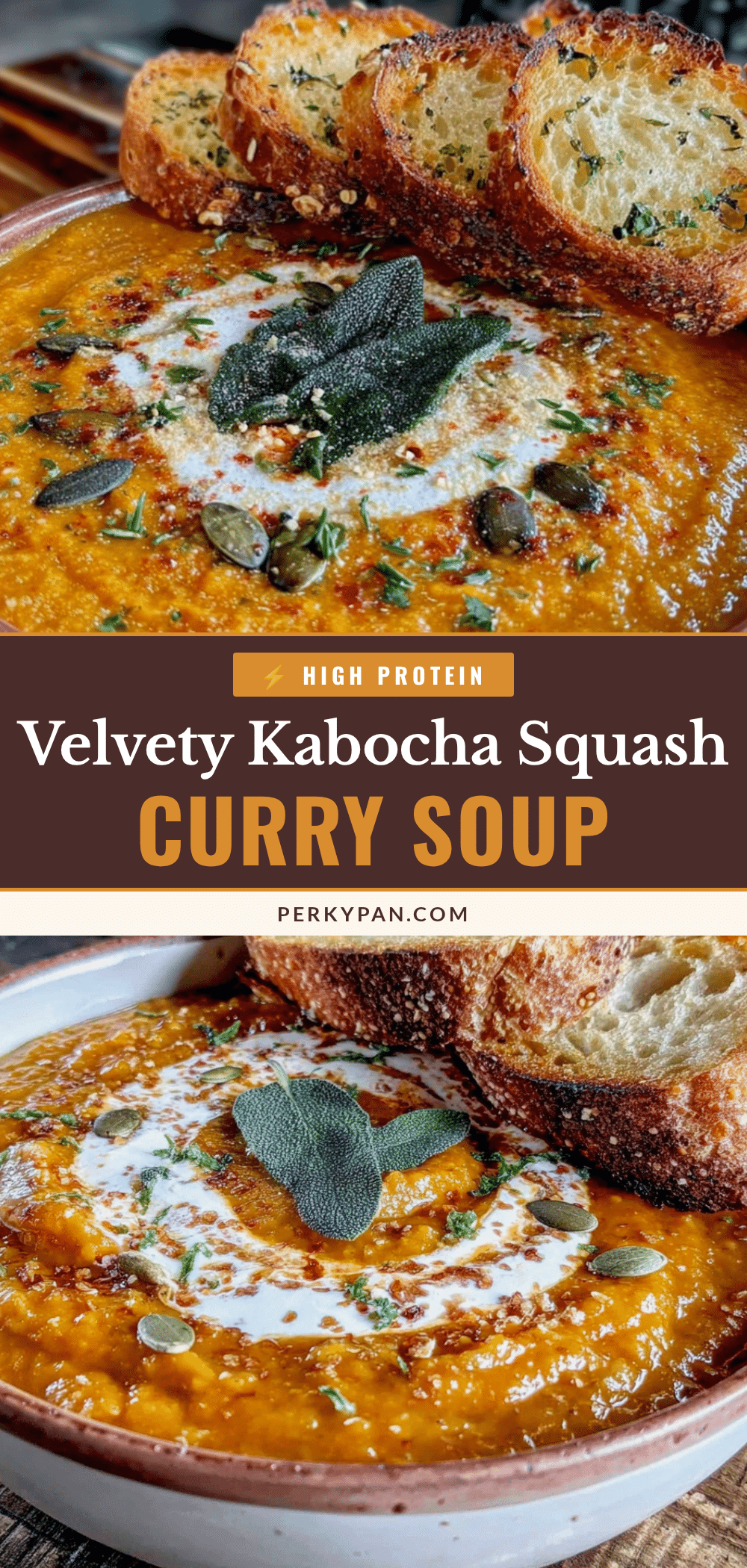
Velvety Kabocha Squash Curry Soup: Easy 20-Minute Recipe

A quick and comforting kabocha squash soup with red curry and coconut milk, made without peeling the squash for an unbelievably velvety texture. Ready in under 20 minutes, it’s perfect for busy weeknights.
- Prep Time: 5 minutes
- Cook Time: 18 minutes
- Total Time: 23 minutes
- Yield: 4 servings 1x
- Category: Soup
- Cuisine: Thai-inspired
Ingredients
- 1 medium kabocha squash (about 2–3 pounds), washed and cubed with skin on
- 1 tablespoon coconut oil (or any neutral oil)
- 1 medium yellow onion, diced
- 3 cloves garlic, minced
- 1 tablespoon fresh ginger, grated
- 2 tablespoons red curry paste
- 1 can (13.5 oz) full-fat coconut milk
- 3 cups vegetable broth (low-sodium preferred)
- 1 tablespoon maple syrup or coconut sugar
- Salt and black pepper, to taste
- Fresh cilantro, chopped (for garnish)
- Toasted pumpkin seeds (for garnish)
- A drizzle of coconut milk (for garnish)
- Lime wedges (for serving)
Instructions
- Prepare the squash: Wash the kabocha squash thoroughly. Cut it in half through the stem end, scoop out the seeds and stringy bits, then cut into 1-inch chunks.
- Sweat the aromatics: Heat coconut oil in a large pot over medium heat. Add diced onion and cook for 3-4 minutes until translucent. Add minced garlic and grated ginger, cook for 30 seconds until fragrant.
- Bloom the curry paste: Add red curry paste to the pot and stir for 1 minute until fragrant.
- Add the squash and liquids: Add cubed squash, coconut milk, vegetable broth, maple syrup, and a pinch of salt. Stir to combine.
- Simmer until tender: Bring to a boil, then reduce heat to low and simmer uncovered for 15-18 minutes, until squash is fork-tender.
- Blend until velvety: Remove from heat. Use an immersion blender to blend until smooth. If using a regular blender, let soup cool for 10 minutes, then blend in batches, filling no more than halfway.
- Adjust and serve: Taste and adjust seasoning with salt, pepper, or lime juice. Ladle into bowls and garnish with cilantro, pumpkin seeds, a drizzle of coconut milk, and lime wedges.
Notes
Don’t skip blooming the curry paste—it deepens the flavor. Cut squash into uniform 1-inch cubes for even cooking. Adjust salt at the end since curry paste and broth contain sodium. If soup is too thick, thin with broth; if too thin, simmer longer. For a regular blender, let soup cool before blending to avoid accidents.
Nutrition
- Serving Size: 1.5 cups
- Calories: 285
- Sugar: 10
- Fat: 18
- Saturated Fat: 14
- Carbohydrates: 28
- Fiber: 5
- Protein: 5
Keywords: kabocha squash soup, curry soup, vegan soup, gluten-free soup, easy soup recipe, 20-minute meal, fall soup, coconut curry soup