Love this? Save it for later!
Share the inspiration with your friends
I was standing in line at my local hardware store—of all places—waiting to return a paint sprayer that I’d clearly used wrong, when the woman behind me started talking about bread. Not just any bread, mind you. She was describing a Pan de Muerto with such detail, such reverence, that I almost forgot why I was there. She was the accountant from two blocks down, a quiet woman I’d only ever seen shuffling papers and sipping black coffee. But there she was, telling me about the orange blossom water her grandmother brought from Mexico City, and how it made the glaze sing. I wasn’t expecting baking advice from my neighborhood numbers person, but honestly, that conversation changed my entire approach to this bread.
She told me about the first time she made it for her husband’s family—how she’d been terrified, how the kitchen looked like a flour bomb went off, and how she’d forgotten to set the timer and the bread came out darker than she’d hoped. But nobody cared. They ate it warm, pulling pieces apart with their hands, dipping it in coffee. That image stuck with me. Maybe you’ve been there—standing in a messy kitchen, hoping something turns out okay, and realizing that the people around you don’t care about perfect. They care about being together.
This Pan de Muerto with Orange Blossom Glaze became my go-to for hosting. It’s the bread that makes people stop mid-conversation. It’s soft, slightly sweet, and that floral glaze? It’s the kind of thing that makes you close your eyes after the first bite. I’ve made it for Dia de los Muertos gatherings, for fall dinner parties, and honestly, for no reason at all except that I wanted to smell orange blossoms on a Tuesday. Let me tell you—this recipe stays with you.
Why You’ll Love This Recipe
I’ve tested this Pan de Muerto recipe more times than I can count, and I mean that in the best way. Each batch taught me something new—how humidity affects the dough, why patience with the yeast matters, and that the orange blossom glaze is non-negotiable for that wow factor. This isn’t just another bread recipe. It’s the one that gets asked for by name at every gathering.
- Impressive for Hosting: This bread looks like you spent hours decorating it, but the shaping is simpler than it looks. Your guests will think you’re a professional baker.
- Perfect for Gatherings: Whether it’s a Dia de los Muertos celebration, a fall dinner party, or a festive brunch, this bread steals the show. It’s the centerpiece people gather around.
- Crowd-Pleaser: I’ve served this to kids who usually ignore baked goods and adults who claim they don’t like sweet bread. Every single person goes back for seconds.
- Make-Ahead Friendly: The dough can be prepared the day before your party. Just shape and bake when guests arrive—your kitchen will smell incredible.
- Unbelievably Delicious: The combination of soft, pillowy bread with that fragrant orange blossom glaze is next-level. It’s comfort food with a touch of elegance.
What makes this version different? It’s the balance. The dough is enriched with butter and eggs for tenderness, but it’s not heavy. The orange blossom glaze is floral without being overpowering—it’s like sunshine in frosting form. I’ve tried versions that were too dry, too sweet, or too dense. This one hits all the right notes. It’s the kind of bread that makes you feel like a host who has it all together, even if you’re serving it on paper plates.
What Ingredients You Will Need
This Pan de Muerto uses simple, wholesome ingredients to deliver that signature soft texture and beautiful flavor. Most of these are pantry staples, which makes it easy to whip up when you’re planning a gathering.
For the Dough
- All-purpose flour, 4 cups (500g) – I prefer King Arthur Flour for consistent results, but any good brand works
- Active dry yeast, 2 ¼ teaspoons (one packet) – Make sure it’s fresh for the best rise
- Warm milk, ½ cup (120ml) – Whole milk adds richness, but 2% works fine
- Warm water, ¼ cup (60ml) – Helps activate the yeast
- Granulated sugar, ½ cup (100g) – Adds sweetness and helps feed the yeast
- Unsalted butter, ½ cup (113g), softened – Room temperature is key for easy mixing
- Large eggs, 3, room temperature – This gives the bread its tender crumb
- Orange zest, from 1 large orange – Fresh zest makes a huge difference in flavor
- Vanilla extract, 1 teaspoon – Pure vanilla, not imitation, for the best taste
- Salt, 1 teaspoon – Balances the sweetness
- Orange blossom water, 1 tablespoon – This is the secret ingredient that makes it special
For the Orange Blossom Glaze
- Powdered sugar, 1 ½ cups (180g)
- Orange blossom water, 2 tablespoons
- Fresh orange juice, 1-2 tablespoons – Adjust for desired consistency
- Orange zest, for garnish
For the Decoration
- Additional sugar, for sprinkling – I use coarse sanding sugar for sparkle
- Orange zest, for garnish
A note on orange blossom water: You can find it at Middle Eastern grocery stores, specialty baking shops, or online. A little goes a long way, so don’t go overboard. I’ve used the Cortas brand for years and it’s reliable. For the butter, I recommend using European-style butter if you can—it has a higher fat content that makes the dough extra tender.
Equipment Needed
- Stand mixer with dough hook – Makes kneading effortless, but you can do it by hand
- Large mixing bowl – For rising the dough
- Baking sheet – Line with parchment paper for easy cleanup
- Rolling pin – For shaping the bone decorations
- Sharp knife or bench scraper – For cutting dough
- Pastry brush – For applying the glaze
- Cooling rack – Allows air to circulate so the bread doesn’t get soggy
- Kitchen scale – I highly recommend weighing ingredients for consistent results
- Plastic wrap or clean kitchen towel – For covering dough while it rises
If you don’t have a stand mixer, don’t worry. I’ve made this bread by hand many times. It takes about 10 minutes of kneading, and it’s actually kind of meditative. Just make sure your surface is lightly floured and you’re using a good rhythm. For the baking sheet, any rimmed sheet pan will work—just don’t use a dark non-stick pan, as it can cause the bottom to brown too quickly.
Preparation Method
- Activate the yeast: In a small bowl, combine the warm water (about 110°F/43°C), 1 tablespoon of sugar, and the yeast. Stir gently and let it sit for 5-10 minutes until it becomes frothy. If it doesn’t foam, your yeast might be dead—start over with fresh yeast. I learned this the hard way after wasting an entire batch of ingredients.
- Mix the dry ingredients: In the bowl of your stand mixer, whisk together the flour, remaining sugar, salt, and orange zest. This distributes the zest evenly so every bite has flavor.
- Combine wet ingredients: In a separate bowl, whisk together the warm milk, eggs, vanilla extract, and orange blossom water. Make sure the milk is warm but not hot—you don’t want to scramble the eggs.
- Form the dough: Add the yeast mixture and the wet ingredients to the dry ingredients. Mix on low speed with the dough hook until a shaggy dough forms, about 2 minutes. Add the softened butter, one tablespoon at a time, mixing on medium-low after each addition. This takes patience, but it’s worth it for a silky dough.
- Knead the dough: Increase speed to medium and knead for 8-10 minutes. The dough should be smooth, elastic, and slightly tacky but not sticky. It should pass the windowpane test—stretch a small piece; if it forms a thin, translucent membrane without tearing, it’s ready. If it tears, knead for another 2 minutes and test again.
- First rise: Shape the dough into a ball and place it in a lightly greased bowl. Cover with plastic wrap or a damp kitchen towel. Let it rise in a warm, draft-free place for 1.5 to 2 hours, until doubled in size. I usually put it in my oven with the light on—it’s the perfect cozy spot.
- Shape the dough: Punch down the dough to release the air. Turn it out onto a lightly floured surface. Divide the dough into two pieces—one larger piece (about two-thirds of the dough) for the base, and one smaller piece for the decorations.
- Form the base: Shape the larger piece into a round loaf. Place it on your prepared baking sheet. It should be about 6-7 inches in diameter and about 2 inches tall.
- Create the decorations: Divide the remaining dough into small pieces. Roll four pieces into ropes about 6 inches long—these will be the “bones” that go on top. Roll one piece into a small ball for the top knot. To shape the bones, roll each rope into a log, then gently press the ends to flatten them slightly. They should look like little bones or teardrops.
- Assemble the bread: Arrange the four bone pieces on top of the loaf in a cross pattern, with the flattened ends meeting in the center. Place the small ball in the center. Gently press everything into the dough so it sticks during baking.
- Second rise: Cover the shaped bread loosely with plastic wrap and let it rise for another 45 minutes to 1 hour. It should look puffy and have nearly doubled in size. Don’t skip this—it’s what gives the bread that light, airy texture.
- Preheat the oven: About 15 minutes before the second rise is done, preheat your oven to 350°F (175°C). Position the rack in the center of the oven.
- Bake the bread: Bake for 25-30 minutes, until the top is golden brown and the bread sounds hollow when tapped on the bottom. If the top is browning too quickly, tent it loosely with aluminum foil after 15 minutes. My oven runs hot, so I usually check at 20 minutes.
- Cool the bread: Let the bread cool on the baking sheet for 10 minutes, then transfer it to a wire rack to cool completely. This is important—if you glaze it while it’s still warm, the glaze will just melt off.
- Make the glaze: While the bread cools, whisk together the powdered sugar, orange blossom water, and enough orange juice to reach a thick but pourable consistency. It should coat the back of a spoon.
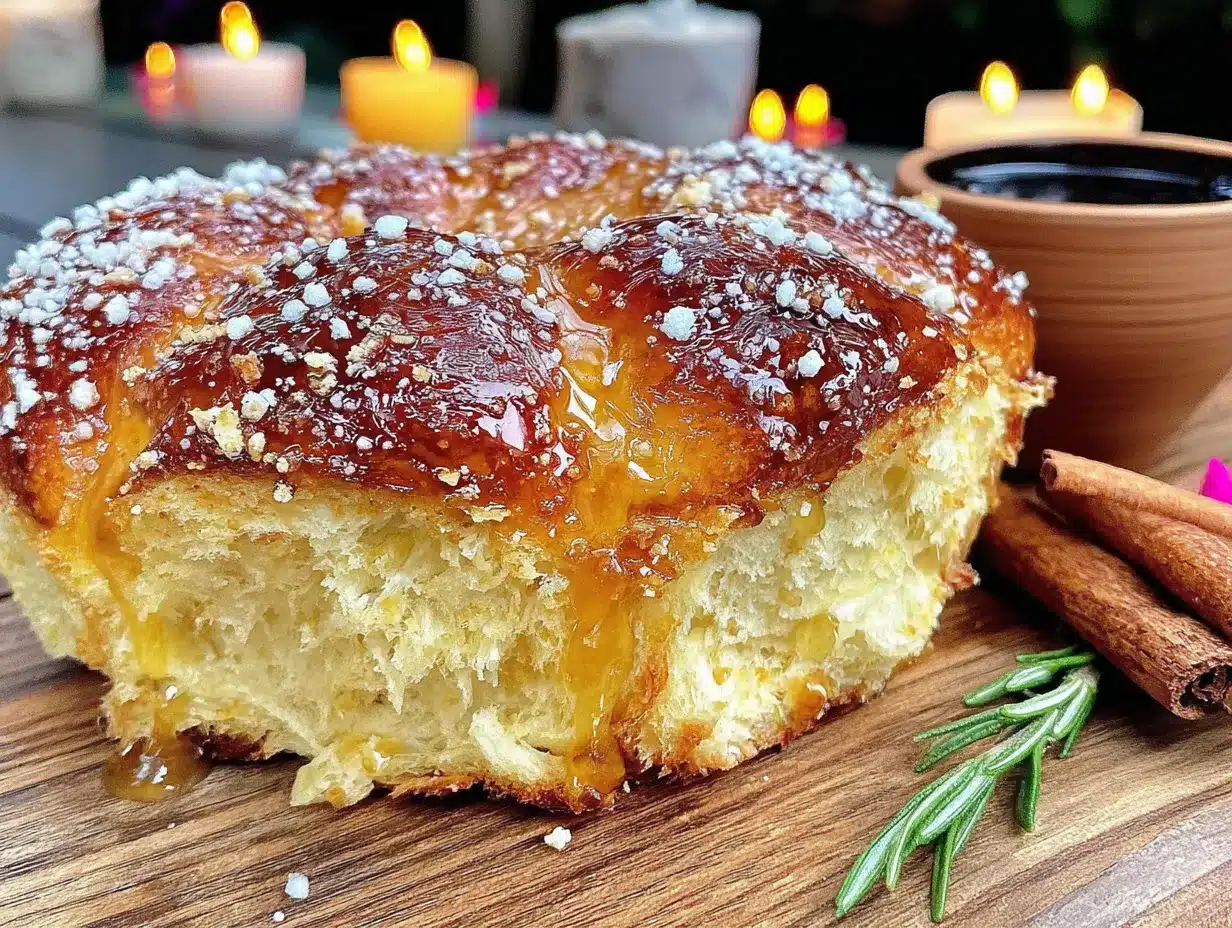
- Glaze and decorate: Once the bread is completely cool, drizzle the glaze over the top. Let it drip down the sides naturally. Sprinkle with coarse sugar and fresh orange zest while the glaze is still wet. Let it set for about 15 minutes before serving.
Cooking Tips & Techniques
The first time I made Pan de Muerto, I got impatient with the second rise and baked it too early. The result was a dense, sad loaf that looked more like a hockey puck than a festive bread. Learn from my mistakes—patience is everything with yeast doughs.
Here’s the thing about working with enriched dough: it’s stickier than lean bread dough. Don’t be tempted to add too much flour during kneading. A slightly tacky dough will yield a softer bread. If it’s sticking to everything, try using a bench scraper to lift and fold it rather than adding flour.
For the orange blossom glaze, less is more when it comes to the orange blossom water. Start with the amount I’ve listed, taste it, and add more if you want a stronger floral note. It’s potent stuff—a little too much and it starts tasting like perfume.
Temperature matters more than you think. Your eggs and butter should be at room temperature. Cold ingredients will seize up the dough and make it harder to knead. If you forgot to take them out ahead of time, place the eggs in a bowl of warm water for 5 minutes and microwave the butter in 5-second bursts until it’s soft but not melted.
When shaping the bone decorations, don’t overthink it. They don’t have to be perfect—in fact, slightly imperfect ones look more authentic. Think of them as rustic bones that add character to the bread.
Variations & Adaptations
One of my favorite things about this recipe is how adaptable it is. I’ve played around with it quite a bit, and here are some variations that work beautifully:
Citrus Medley Version
Swap half the orange zest for lemon or lime zest. The combination of citrus notes with the orange blossom glaze is bright and refreshing. I made this for a spring brunch and it was gone in minutes.
Dairy-Free Adaptation
Use vegan butter and your favorite plant-based milk. The texture will be slightly less tender, but still delicious. I’ve used oat milk with good results—it has enough fat to mimic whole milk.
Spiced Variation
Add 1 teaspoon of ground cinnamon and ½ teaspoon of ground nutmeg to the dry ingredients. This gives the bread a warm, cozy flavor that’s perfect for fall gatherings. It pairs beautifully with the orange blossom glaze.
Chocolate Drizzle Version
For a more decadent take, skip the orange blossom glaze and drizzle melted dark chocolate over the top instead. Sprinkle with sea salt and orange zest. It’s less traditional but absolutely delicious.
Mini Bread Version
Divide the dough into 8-10 smaller pieces and shape each into a mini loaf with decorations. Bake for 15-18 minutes instead of 25-30. These are perfect for party favors or individual servings.
Serving & Storage Suggestions
This Pan de Muerto is best served at room temperature or slightly warm. If you’re hosting, you can bake it a few hours ahead and let it cool completely before glazing. The glaze sets beautifully and the bread stays fresh for hours.
For serving, I like to place the bread on a wooden board or a decorative cake stand. It’s such a beautiful bread that it deserves to be the centerpiece. Pair it with hot coffee, Mexican hot chocolate, or a cup of strong black tea. The floral notes of the glaze complement these drinks perfectly.
If you’re having a Dia de los Muertos gathering, serve it alongside tamales, mole, or a simple black bean soup. The sweetness of the bread balances the savory dishes beautifully. For a dessert spread, offer it with fresh fruit, whipped cream, or a side of cajeta (goat’s milk caramel).
To store leftovers, wrap the bread tightly in plastic wrap or place it in an airtight container. It will keep at room temperature for up to 3 days. The glaze may soften slightly, but the flavor will still be wonderful. I actually think it gets better on day two—the flavors meld together.
For longer storage, you can freeze the unglazed bread for up to 3 months. Wrap it tightly in plastic wrap and then in foil. When you’re ready to serve, thaw it at room temperature, then warm it in a 300°F oven for 5-10 minutes. Glaze it after it cools. The texture will be just as good as fresh.
To reheat individual slices, pop them in the toaster or microwave for 10-15 seconds. Just don’t overheat it, or the glaze will melt.
Nutritional Information & Benefits
I’m not a nutritionist, but I can tell you what I know about this bread. One serving (about 1/8 of the loaf) contains approximately 320 calories, 8g of fat, 55g of carbohydrates, and 6g of protein. The actual numbers will vary depending on your ingredients and portion sizes.
On the plus side, this bread does have some redeeming qualities. The orange zest provides a small amount of vitamin C and antioxidants. The eggs add protein and healthy fats. And honestly, there’s something to be said for the mental health benefits of sharing homemade bread with people you love.
If you’re watching your sugar intake, you can reduce the sugar in the dough to ⅓ cup and use a lighter hand with the glaze. The bread will still be delicious, just less sweet. For a gluten-free version, I haven’t tested it with gluten-free flour, but a good 1:1 baking blend might work—just know the texture will be different.
Potential allergens: This recipe contains wheat (gluten), dairy, and eggs. It’s not suitable for those with celiac disease or severe gluten intolerance unless you use certified gluten-free flour.
Conclusion
This Pan de Muerto with Orange Blossom Glaze is more than just a recipe—it’s a conversation starter, a centerpiece, and a way to bring people together. It’s the bread that makes your kitchen smell like a bakery and your guests feel special. Whether you’re celebrating Dia de los Muertos, hosting a fall gathering, or just want to try something new, this bread delivers every single time.
I’ve made this for quiet Tuesday nights and for big parties, and it never fails to impress. The soft, tender crumb, the fragrant glaze, the beautiful shape—it’s a labor of love that’s absolutely worth it. And honestly, the best part is watching people’s faces when they take that first bite. That moment of surprise and delight? That’s why I keep making it.
Now I want to hear from you. Have you ever made Pan de Muerto before? What’s your favorite way to serve it? Drop a comment below and let me know. And if you try this recipe, tag me in your photos—I’d love to see your beautiful bread! Don’t forget to share this recipe with your friends and family. Happy baking!
Frequently Asked Questions
Can I make Pan de Muerto ahead of time?
Absolutely. You can prepare the dough through the first rise, then refrigerate it overnight. The next day, let it come to room temperature for about 30 minutes, then shape, rise, and bake as directed. The cold fermentation actually develops more flavor.
What if I can’t find orange blossom water?
You can substitute with 1 teaspoon of orange extract mixed with 1 tablespoon of water, or simply use fresh orange juice and extra zest. The flavor won’t be exactly the same, but it will still be delicious. Rose water is another option, though it has a different floral note.
Why did my bread turn out dense?
This usually happens for one of three reasons: your yeast was old or dead, you didn’t knead the dough enough to develop gluten, or you didn’t let it rise long enough. Make sure your yeast is fresh, knead until the dough passes the windowpane test, and be patient with the rising times.
Can I freeze the glazed bread?
I don’t recommend freezing glazed bread because the glaze can become sticky and messy when thawed. Freeze the unglazed bread instead, then thaw, warm, and glaze it fresh. The glaze takes only 2 minutes to make, so it’s worth doing it at the last minute.
How do I shape the bone decorations?
Roll each piece of dough into a rope about 6 inches long. Gently press the ends to flatten them slightly, creating a shape that looks like a bone or a teardrop. Don’t worry about perfection—rustic shapes look more authentic. Arrange them in a cross pattern on top of the loaf, with the flattened ends meeting in the center.
Pin This Recipe!
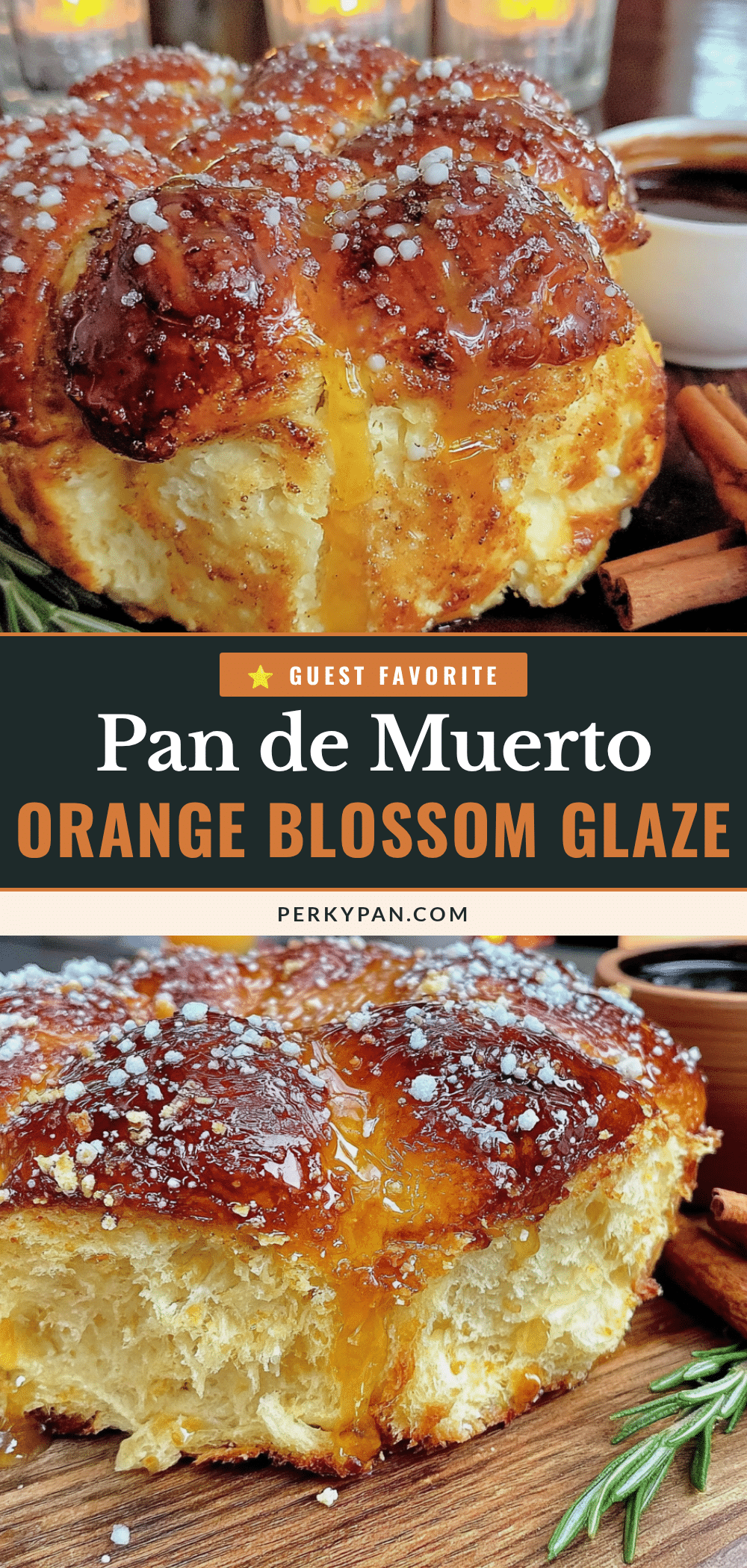
Best Pan de Muerto with Orange Blossom Glaze Recipe
This Pan de Muerto with Orange Blossom Glaze is a soft, slightly sweet bread with a fragrant floral glaze that makes it a show-stopping centerpiece for Dia de los Muertos gatherings or any fall celebration. It’s the bread that makes people stop mid-conversation and go back for seconds.
- Prep Time: 30 minutes
- Cook Time: 25-30 minutes
- Total Time: 3 hours 15 minutes (including rising time)
- Yield: 8 servings 1x
- Category: Bread
- Cuisine: Mexican
Ingredients
- 4 cups (500g) all-purpose flour
- 2 ¼ teaspoons active dry yeast (one packet)
- ½ cup (120ml) warm milk
- ¼ cup (60ml) warm water
- ½ cup (100g) granulated sugar
- ½ cup (113g) unsalted butter, softened
- 3 large eggs, room temperature
- Zest of 1 large orange
- 1 teaspoon vanilla extract
- 1 teaspoon salt
- 1 tablespoon orange blossom water
- 1 ½ cups (180g) powdered sugar
- 2 tablespoons orange blossom water
- 1–2 tablespoons fresh orange juice
- Additional orange zest for garnish
- Coarse sanding sugar for sprinkling
Instructions
- Activate the yeast: In a small bowl, combine warm water (about 110°F/43°C), 1 tablespoon of sugar, and the yeast. Stir gently and let sit for 5-10 minutes until frothy.
- Mix dry ingredients: In the bowl of a stand mixer, whisk together flour, remaining sugar, salt, and orange zest.
- Combine wet ingredients: In a separate bowl, whisk together warm milk, eggs, vanilla extract, and orange blossom water.
- Form the dough: Add yeast mixture and wet ingredients to dry ingredients. Mix on low speed with dough hook until shaggy dough forms, about 2 minutes. Add softened butter one tablespoon at a time, mixing on medium-low after each addition.
- Knead the dough: Increase speed to medium and knead for 8-10 minutes until smooth, elastic, and slightly tacky. Dough should pass the windowpane test.
- First rise: Shape dough into a ball and place in a lightly greased bowl. Cover with plastic wrap or damp towel. Let rise in a warm, draft-free place for 1.5 to 2 hours until doubled in size.
- Shape the dough: Punch down dough. Turn out onto a lightly floured surface. Divide into two pieces—one larger piece (about two-thirds) for the base, one smaller for decorations.
- Form the base: Shape larger piece into a round loaf about 6-7 inches in diameter and 2 inches tall. Place on prepared baking sheet.
- Create decorations: Divide remaining dough into small pieces. Roll four pieces into ropes about 6 inches long for ‘bones’. Roll one piece into a small ball for the top knot. Press ends of ropes to flatten slightly.
- Assemble the bread: Arrange four bone pieces on top of loaf in a cross pattern with flattened ends meeting in center. Place small ball in center. Gently press into dough.
- Second rise: Cover shaped bread loosely with plastic wrap and let rise for 45 minutes to 1 hour until puffy and nearly doubled.
- Preheat oven: About 15 minutes before second rise is done, preheat oven to 350°F (175°C) with rack in center.
- Bake the bread: Bake for 25-30 minutes until golden brown and bread sounds hollow when tapped. Tent with foil after 15 minutes if browning too quickly.
- Cool the bread: Let cool on baking sheet for 10 minutes, then transfer to wire rack to cool completely.
- Make the glaze: Whisk together powdered sugar, orange blossom water, and enough orange juice to reach a thick but pourable consistency.
- Glaze and decorate: Once bread is completely cool, drizzle glaze over top. Sprinkle with coarse sugar and fresh orange zest while glaze is wet. Let set for 15 minutes before serving.
Notes
Patience is key with yeast doughs. Ensure yeast is fresh and liquids are at the right temperature (110°F/43°C for water, warm but not hot milk). Room temperature eggs and butter are essential for a smooth dough. Orange blossom water is potent; start with the amount listed and adjust to taste. For a dairy-free version, use vegan butter and plant-based milk. The unglazed bread can be frozen for up to 3 months; thaw and glaze fresh.
Nutrition
- Serving Size: 1/8 of loaf
- Calories: 320
- Sugar: 22
- Sodium: 200
- Fat: 8
- Saturated Fat: 4
- Carbohydrates: 55
- Fiber: 1
- Protein: 6
Keywords: Pan de Muerto, Day of the Dead bread, orange blossom glaze, Mexican sweet bread, Dia de los Muertos recipe, fall bread, festive bread